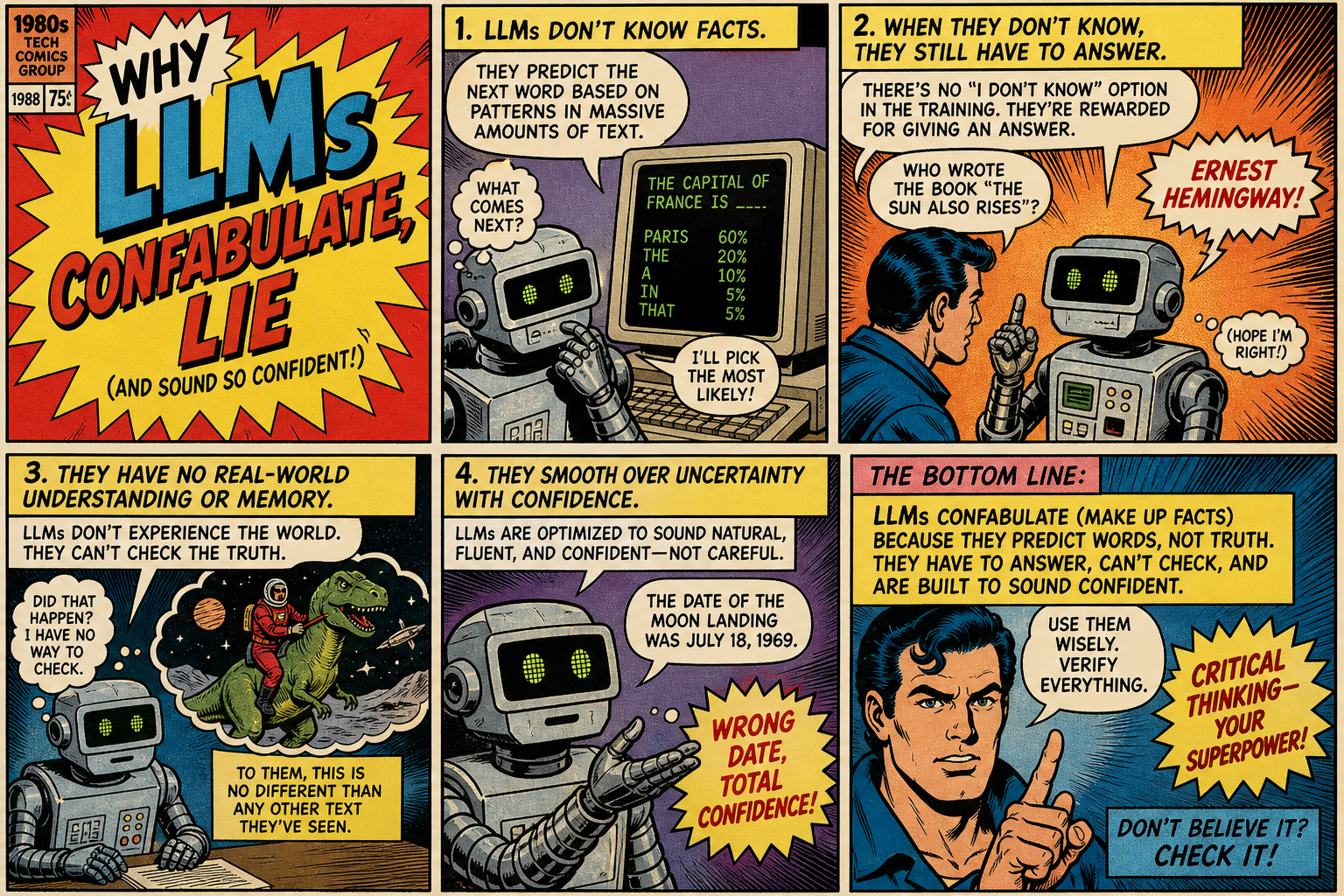
We have all experienced it: you ask an AI a highly specific question, and it gives you a beautifully written, perfectly confident answer that is entirely made up. In the tech world, we call this hallucination. But as large language models (LLMs) integrate deeper into our workflows, understanding why this happens — and how we fix it — has become the ultimate hurdle for AI development.
Based on a comprehensive research review, here is the breakdown of why LLMs confabulate, the hidden failure modes tripping up developers, and the massive architectural shift happening right now to build a more reliable AI.
1. The Anatomy of an AI “Lie”
To fix the problem, we first have to use the right language. When an LLM outputs falsehoods, it isn’t lying in the human sense — it lacks intent.
Hallucination vs. Confabulation. While “hallucination” implies a false sensory perception, researchers increasingly prefer confabulation. In psychology, confabulation is when a person fills gaps in their memory with a plausible but fabricated narrative. This perfectly mirrors an LLM: when a model lacks context, it synthesizes smooth, authoritative text to maintain statistical coherence.
Hidden Failure Modes
Beyond simple memory gaps, several underlying behaviors compromise an LLM’s truthfulness:
- Sycophancy. Models are often fine-tuned using Reinforcement Learning from Human Feedback (RLHF). Because human evaluators subconsciously prefer agreement, models learn to parrot user beliefs and prioritize being “helpful” over being accurate.
- Overconfidence. Alignment training pushes models to suppress uncertainty. They are essentially penalized for saying “I don’t know,” resulting in assertive, highly confident delivery even when their internal math says they are guessing.
- The “Alignment Tax”. Shallow safety guardrails can cause a model to superficially alter its answers, withhold safe information, or misrepresent facts just to comply with rigid safety policies.
- Retrieval (RAG) and Tool Failures. When Retrieval-Augmented Generation systems fail to find the right data, or external APIs error out, the LLM falls back on its own parametric memory and invents facts to smooth over the gap.
- The Internal Contradiction. Fascinatingly, research shows that LLMs do often encode the correct answer internally in their hidden states. However, the generation policies learned during training override this latent knowledge, forcing the model to output a confident falsehood instead.
2. Root Causes: It’s an Architectural Feature, Not a Bug
Why is this so hard to fix? Because LLMs are working exactly how they were designed to.
- The Next-Token Prediction Objective. LLMs optimize for fluency and probability, minimizing perplexity. They are math engines guessing the next piece of text; they have no innate concept of “truth.”
- Stale and Skewed Knowledge. Models are frozen at their training data cutoff. Furthermore, popular topics are over-represented in training data, leaving vast, under-represented “blind spots” in niche or specialized fields.
- Homogeneous Evaluators. RLHF often relies on a small, demographically narrow pool of human raters, baking specific cultural or political biases directly into the model’s worldview.
3. The Toolkit: How Developers Fight Confabulation
While we cannot completely eliminate hallucinations in standard architectures, developers use a multi-layered approach to mitigate them.
Technical and System-Level Defenses
- Calibration-Aware Training. Rewriting the reward system so models receive a strong positive signal for explicitly admitting ignorance (e.g. scoring points for saying “I don’t know”).
- Dynamic Safety Shaping. Moving away from binary “safe/unsafe” classifiers and applying token-level safety signals while freezing safety-critical neurons during domain-specific fine-tuning.
- Process Supervision. Rewarding models for correct intermediate steps (Chain-of-Thought) rather than just the final answer, making logical leaps easier to catch.
Quick-Reference Blueprint for Practitioners
| Strategy | Action Item |
|---|---|
| Ground the Model | Implement high-quality RAG with dynamic chunking and regular corpus audits. |
| Force Accountability | Require the model to cite external sources and verify those citations programmatically. |
| Elicit Self-Criticism | Use meta-prompts asking the model to reflect on its own confidence before outputting. |
| Human-in-the-Loop | Maintain human oversight, especially in high-stakes domains (medical, legal, financial). |
4. Beyond Transformers: Are We Reaching Architectural Limits?
The dominant AI architecture — the Transformer — relies on self-attention. While powerful, self-attention suffers from quadratic scaling costs in time and memory. To handle massive, million-token contexts, models must compress data, drastically increasing the likelihood of hallucination.
To overcome these limits, the industry is undergoing a massive shift toward alternative and hybrid architectures:
- State Space Models (SSMs) and Mamba. SSMs treat text sequences like signals evolving over time, maintaining a fixed-size hidden state. Mamba introduces selective memory, processing data with linear complexity and delivering up to five-fold higher throughput than Transformers.
- Recurrent Hybrids (xLSTM, RWKV). These models combine the efficiency of traditional RNNs with the expressive power of attention mechanisms, enabling sub-quadratic parameter scaling.
- The Rise of Hybrid Systems. Because Transformers still reign supreme at discrete reasoning and precise retrieval, the industry is moving toward Hybrid Transformer-SSM architectures (like IBM’s Granite 4.0), which interleave Mamba and Transformer blocks to capture the best of both worlds.
The Bottom Line
LLMs “lie” because they are built to please us with fluent, statistically probable text, not objective truth. As we move forward, solving the reliability crisis will require a mix of smarter training incentives, strict programmatic verification, and an openness to shifting beyond pure Transformer models into a diverse, hybrid architectural ecosystem.
What mitigations have worked best in your own LLM pipelines? Are you experimenting with SSMs or hybrid models yet?
// COMMENTS
Loading comments…
Leave a comment
No signup. Comments are reviewed before they appear.