
The Exploit Does Not Need to Be Intelligent
How assisted reconnaissance, coordination and concealment could increase the pressure on critical infrastructure.
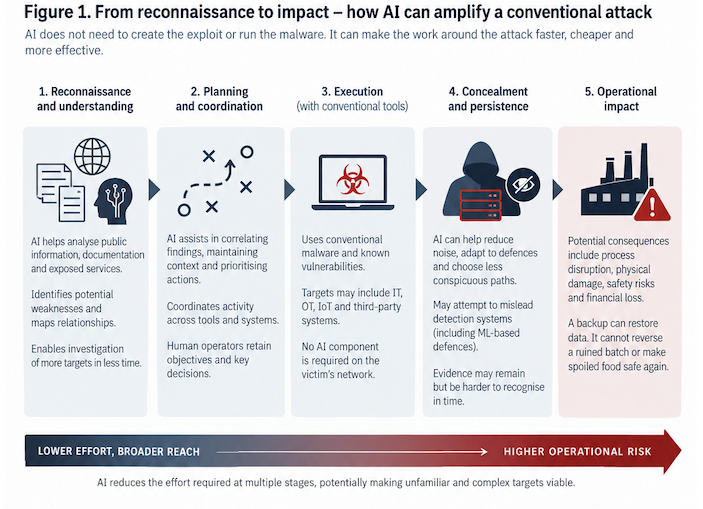
A backup can restore data. It cannot reverse a ruined batch or spoiled food.
For critical infrastructure, industrial control systems and connected equipment, that is the uncomfortable line between a cyber incident and physical loss. What the malware can do is only part of the problem. The larger part is how efficiently an attacker can understand the environment, coordinate activity and stay below the detection threshold long enough.
Two incidents in the past week make the point from different angles.
Overnight on 11–12 October, attackers altered defrost cycles on refrigeration controllers in hundreds of French supermarkets. Stores threw away fresh and frozen food; one cold room reached 50 °C before anyone noticed the damage. CERT-FR’s alert of 12 October confirmed numerous compromises of Danfoss AK-SM and AK-SC controllers and was extended the following day to Copeland and Dixell xweb units, with a warning that the campaign was probably still running. The alert names no vulnerability. It does say that management interfaces were exposed to the internet, that operators should check their defrost schedules, and that a factory reset alone is not enough for end-of-life equipment, which stays open to renewed compromise. Nothing in the alert attributes the attacks to assisted tooling.
Japan’s wave of web-system breaches raises a different question. Macnica’s analysis of 7 October counts 119 publicly disclosed incidents this year through 6 October in which personal data was taken from web systems run by Japanese organisations, against 84 in all of 2025 and 62 in 2024. Eighty-one of this year’s cases were disclosed since July. The methods, confirmed through incident response and log analysis, are unremarkable: scanning for known vulnerabilities and exposed configuration files, abuse of administrative interfaces found by reverse-engineering mobile apps, SQL injection against an analytics tool. What stands out is the breadth and the amount of target-specific probing. Macnica’s analysts consider machine assistance a plausible explanation for that breadth, and say plainly that no log or trace proves it. That is an informed suspicion, not a confirmed campaign. Similar cases have been counted in thirteen other countries, so the pattern is regional rather than Japanese.
Uncertainty about these particular incidents should not hide the wider risk.
Smarter coordination. Ordinary malware.
Assistance does not have to invent a vulnerability to make an attack more effective. The UK’s National Cyber Security Centre, in its May 2025 assessment of the threat to 2027, judges that threat actors are almost certainly already using such tools to enhance reconnaissance and other established techniques, that this will highly likely increase the threat to critical infrastructure and poorly secured operational technology, and that fully automated, end-to-end advanced attacks remain unlikely within that horizon.
Our concern is what this does to the organisation of an attack.
An assisted coordinator could interpret findings, connect scattered information, hold context and support decisions across conventional tools and malware. The human operators keep control. They hand off more of the investigative workload.
Such a coordinator does not need to sit inside the victim’s network. Finding ordinary malware on a compromised system therefore says nothing about whether assistance was at work elsewhere in the operation.
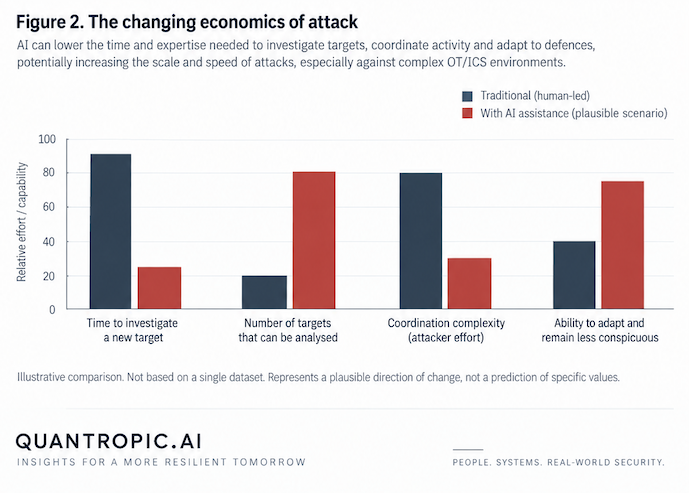
This is a plausible architecture, not an attribution of the recent incidents. Its significance is economic: an unfamiliar target becomes cheaper to understand, and a complicated attack cheaper to coordinate.
The weakness may be old. The effort required to exploit it may be changing.
An attack does not need to be invisible
Better coordination also supports better disguise. The NCSC anticipates assisted evasion and warns that cooperation between operators and tooling could make malicious activity harder to identify and track.
A related concern is the manipulation of defensive interpretation itself. Han and colleagues (IEEE JSAC, 2021) showed that machine-learning-based network intrusion detectors can be evaded by mutating traffic with very limited knowledge of the detector and without breaking the traffic’s function; against one state-of-the-art system they reached evasion rates above 97 per cent in half of the tested cases. The same work proposes a defence. It establishes neither a universal bypass nor any link to France or Japan.
The risk scenario is credible all the same: assistance helping an attacker cut unnecessary activity, coordinate apparently unrelated actions and make malicious behaviour less conspicuous.
Covering tracks does not have to mean deleting every record. The French supermarkets had temperature data. It came from the same controllers that had been told to defrost, and nobody read its significance until the morning.
For an operational process, detection after the damage is still a failure to prevent it.
What our assessment experience shows
One assessment that shaped Quantropic’s practice took place at a Malaysian plant. A trusted support-service relationship was followed across the plant boundary to a demonstrated manipulation of an industrial controller. The finding was about the authority accepted through supporting infrastructure, not about the security of the controller on its own.
A connection may serve a legitimate purpose. An account may be necessary. A service may be trusted. The decisive question is what those elements permit when you look at them together.
Our assessment method connects communication, access, system behaviour and operational consequences. The result we want is an understanding of how an actor could turn an available capability into a consequential action. A vulnerability list on its own does not give you that.
We apply the same discipline to the security of models introduced into operational workflows. Our industrial prompt-manipulation example was a laboratory demonstration, and it addresses a separate but related concern. Whether assistance sits outside the organisation or becomes a manipulable component inside it, the assessment has to follow information and authority through to their possible consequences.
Test the relationships before an attacker does
The answer is not to abandon established industrial security for a contest of tooling against tooling. IEC 62443 remains the relevant foundation for risk-based protection across industrial systems and their lifecycle.
The practical question is whether the controls still hold when an adversary can investigate more targets and coordinate activity more efficiently.
Which trusted services can influence a critical process? What limits their authority? Which safeguards remain independent when a trusted component is compromised? Would monitoring recognise misuse before the process suffers?
These questions deserve evidence. A network diagram is not evidence.
A useful starting point is one critical process and the complete set of relationships capable of changing it. Examine those relationships together, not as separate items owned by separate teams.
The exploit does not need to be intelligent for the operation around it to become more effective.
Sources
- CERT-FR, Alert CERTFR-2026-ALE-012, 12 October 2026, updated 13 October 2026
- Macnica Security Research Center, analysis of the series of information-leak incidents from web systems, 7 October 2026
- JPCERT/CC, alert of 8 October 2026
- National Cyber Security Centre (UK), Impact of AI on cyber threat from now to 2027, May 2025
- D. Han et al., Evaluating and Improving Adversarial Robustness of Machine Learning-Based Network Intrusion Detectors, IEEE Journal on Selected Areas in Communications, 2021 (arXiv:2005.07519)
- ISA/IEC 62443 series
- Quantropic, Technical Assessment methodology; Secure AI Transformation
// COMMENTS
Loading comments…
Leave a comment
No signup. Comments are reviewed before they appear.