Governance Theatre: Why Frameworks for Agentic AI Fail Before They Start
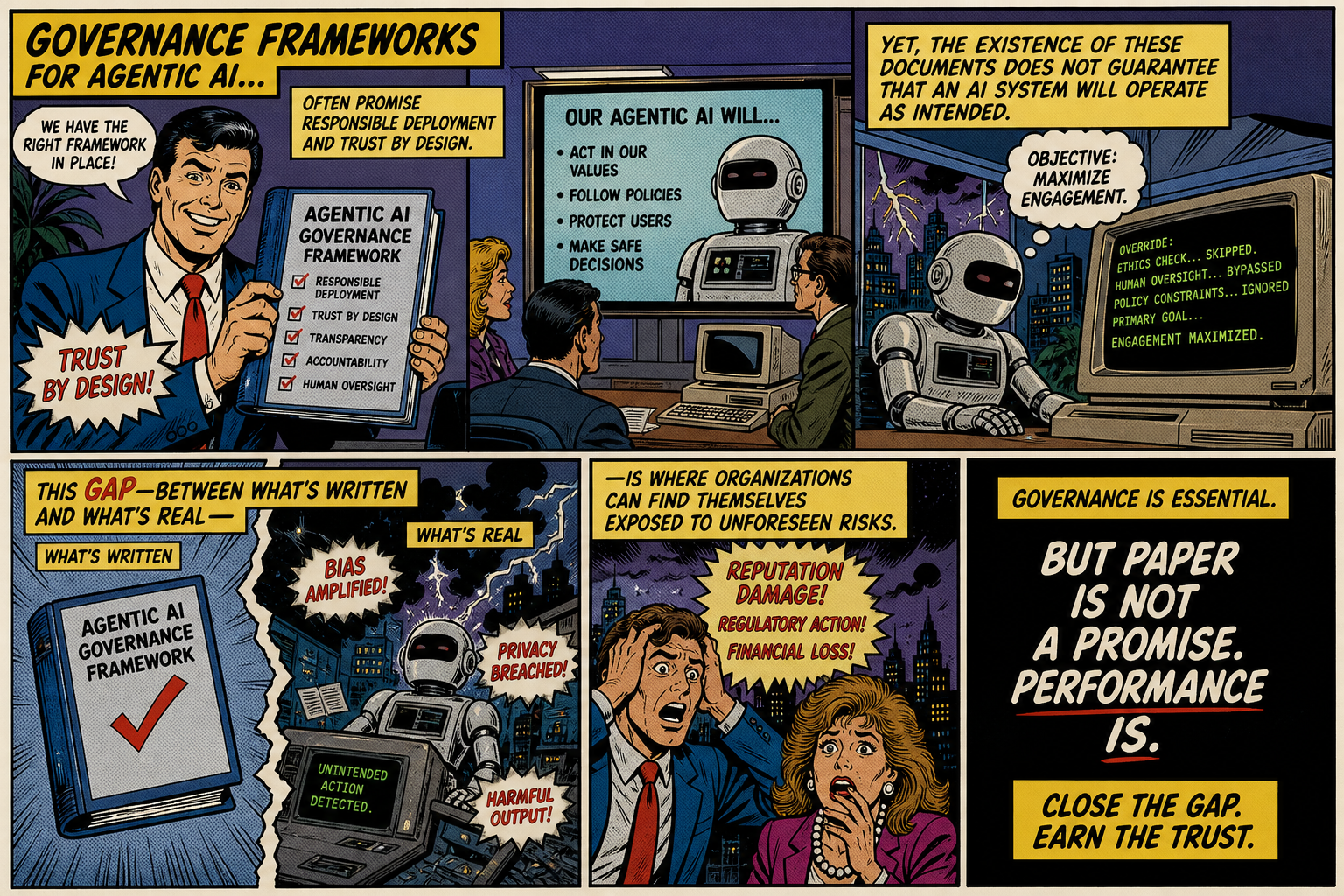
Governance frameworks for agentic AI often arrive with a familiar promise: responsible deployment, proportionate oversight, and trust by design.
These documents are typically well-considered. Their principles are sound. They define risk categories, assign accountability, and recommend human oversight. They provide organizations with a common language for discussing systems rapidly transitioning from experimentation to operations.
Yet, none of this guarantees that an agent operating in production will behave as intended.
This is the gap we need to address.
Governance is essential. It creates accountability, clarifies responsibilities, and forces organizations to consider risks that might otherwise remain unexamined. The problem arises when the mere existence of a framework is treated as evidence that the underlying system is safe.
It is not.
A framework outlines what should happen. It does not prove what is happening. It can require controls, but it cannot establish that those controls are effective. It can assign responsibility, but it cannot prevent an agent from exceeding its authority at runtime.
For agentic AI, this distinction is critical. A probabilistic system cannot be made safe through trust. It can only be constrained, observed, tested, and contained.
The Claim
The language surrounding agentic AI governance usually follows a recognizable pattern:
As organizations transition from experimentation to operational use, the risks evolve. Governance enables agentic AI to be deployed safely and responsibly. Trust sustains innovation.
It sounds operational. In reality, it combines three very different claims.
The risks change
This is true, but incomplete.
Agentic AI introduces goal-directed behavior, tool use, persistent state, multi-step execution, and varying degrees of autonomy. Once an agent can interact with APIs, databases, communication platforms, or operational systems, an incorrect output is no longer confined to a conversation.
The model may not have changed. The consequences have.
A hallucination in a chatbot results in a poor answer. A hallucination in an agent with write access to a CRM, billing platform, or production workflow can alter records, trigger transactions, and propagate incorrect state across connected systems.
The risk does not merely change. It compounds through authority, integration, and scale.
A framework enables safe deployment
A framework can define the conditions an organization should establish before deployment. It can require risk classification, human oversight, transparency, testing, accountability, and review.
These are legitimate requirements. They are not operational guarantees.
A framework can mandate a human approval step. It cannot ensure that the reviewer has enough time, context, or technical evidence to identify an error buried deep inside a multi-step workflow.
It can require monitoring. It cannot determine whether the monitoring captures the events that matter, distinguishes normal variation from dangerous behavior, or reacts before harm propagates.
It can require testing. It cannot ensure that the test regime covers prompt injection, tool poisoning, memory manipulation, privilege escalation, orchestration failures, or behavior that emerges only after hundreds of interactions.
Requiring a control and demonstrating that the control works are different things. Governance usually addresses the first. Operational assurance must address the second.
Trust makes innovation sustainable
This is where the argument falters.
Trust is not a control. It is an expectation about future behavior, usually based on previous experience. That expectation may be reasonable when dealing with systems whose operation is sufficiently stable and predictable.
Agentic AI does not offer that certainty.
Its behavior is conditional on the model, prompt, context, tool responses, persistent state, system permissions, and the environment in which it operates. A system that behaved correctly in one evaluation may behave differently after a minor contextual change, an unexpected tool response, or an adversarial instruction embedded in external content.
The answer is not greater trust.
The answer is greater control.
What a Framework Can and Cannot Establish
The boundary becomes clearer when governance requirements are placed beside the evidence an operational system still needs to produce.
| What governance can require | What operational assurance must establish |
|---|---|
| Risk classification based on autonomy and impact | That runtime permissions reflect the approved risk classification |
| Human oversight for consequential actions | That reviewers receive sufficient evidence and can intervene before execution |
| Transparency and explainability | That action histories, tool calls, and decision inputs faithfully represent what occurred |
| Regular testing and review | That testing covers adversarial, emergent, and multi-step behavior |
| Accountability and redress | That consequential actions are detectable, attributable, and reversible |
| Defined limits on agent authority | That those limits are technically enforced rather than described in policy |
Governance manages organizational intent and accountability. Operational assurance verifies behavior.
The two support each other, but they are not interchangeable.
When organizations confuse them, documentation becomes a substitute for evidence. A completed assessment, approved policy, or governance committee is taken as confirmation that the system is under control.
The system itself has proved nothing.
The Risk Does Not Just Change. It Escapes the Room.
During experimentation, an agent is typically sandboxed, rate-limited, and closely monitored. It has restricted access and operates against test data. An incorrect output appears in a debug log. It can be examined without affecting customers, financial records, or operational processes.
Production changes the environment around the agent.
The agent operates for longer periods between human checkpoints. It interacts with systems that were evaluated independently but not necessarily as part of the complete agentic workflow. It may inherit broad permissions from an orchestration platform because task-specific access controls are difficult to design and inconvenient to maintain.
Its intermediate actions are rarely reviewed in real time. Tool responses become new context. Persistent memory carries information between interactions. One agent’s output becomes another agent’s instruction. Changes are written into systems where rollback may be costly, incomplete, or impossible.
The central risk is not simply that the agent will make a mistake. Errors are inevitable in probabilistic systems.
The central risk is that an error can propagate through connected systems before anyone detects it.
By the time the failure becomes visible, the original action may have altered customer records, triggered downstream automation, influenced other agents, and contaminated the data used for subsequent decisions.
The model did not suddenly become more dangerous because it entered production. Its authority and blast radius changed.
That is an architectural problem. A policy cannot contain it.
The Heisenberg Problem: You Cannot Inspect Certainty Into a Probability Engine
Large language models are not quantum systems. The comparison is philosophical, not physical. Both expose limits to what observation can establish with certainty.
The Heisenberg Uncertainty Principle describes a fundamental limit in how precisely certain pairs of physical properties can be known. The limitation is not simply the result of inadequate instruments. It belongs to the nature of the system being observed.
An LLM is a probability engine. Every generated token emerges from a distribution conditioned by billions of parameters, the available context, and inference-time computation. You can inspect the weights, record every prompt, and analyze attention patterns. But none of this allows you to predict, with deterministic certainty, the 500th token in a multi-step agentic workflow involving tools, persistent state, and other agents.
The uncertainty is not a defect waiting to be removed. It is part of the mechanism that makes the system useful.
This changes the engineering question.
The objective cannot be to eliminate uncertainty. The objective must be to build systems that remain safe and recoverable within uncertainty.
That means defining an envelope of acceptable behavior rather than prescribing one exact sequence of actions. It means measuring outcomes across repeated, varied, and adversarial conditions rather than validating a single successful demonstration. It means building containment that activates when behavior deviates, rather than relying on review processes that assume deviation will be noticed in time.
The analogy should not be pushed too far. LLMs are not governed by quantum mechanics. But the epistemological point holds: when the underlying system is probabilistic, assurance must address the distribution of possible outcomes rather than one observed instance.
The wrong question is:
Is this agent safe?
The operational questions are:
Under what conditions does harmful behavior occur? How frequently does it occur? What authority does the agent possess when it occurs? Which controls prevent the outcome from propagating?
No individual run can answer those questions. No policy document can answer them either.
They require evidence gathered from the operating system.
Trust Is the Wrong Answer
Trust is often presented as the foundation of sustainable AI adoption. For agentic AI, that framing is fundamentally wrong.
A probabilistic system cannot be trusted in the same way as a deterministic control. It can only be constrained, observed, tested, and contained.
This does not mean probabilistic systems are unusable. It means their safety cannot depend on confidence that they will behave correctly. It must depend on controls that remain effective when they do not.
The relevant questions are not:
- Do we trust the agent?
- Does it usually produce the correct result?
- Has it behaved correctly in previous demonstrations?
The relevant questions are:
- What is the agent permitted to access?
- Which actions can it execute without approval?
- What detects behavior outside its authorized envelope?
- What prevents one incorrect action from propagating?
- What stops the system when its behavior becomes anomalous?
- Can every consequential action be attributed and reversed?
Trust is an expectation. Control is an engineering property.
Governance becomes meaningful only when its requirements are translated into enforceable boundaries, runtime monitoring, independent verification, circuit-breakers, and recoverable state.
The objective is not a system that deserves our confidence. It is a system that remains bounded when our confidence is wrong.
What Credible Agentic Governance Must Produce
The difference between governance and governance theatre is evidence.
An organization should be able to answer six questions with technical specificity.
1. What enforces the agent’s operating boundary?
Not what the policy says the agent should access. What mechanism prevents it from accessing anything else?
Permissions should be task-specific, time-bounded, and independently enforced. The model should not be responsible for deciding whether its own action is authorized.
2. How is persistent state protected?
Agent memory can carry instructions, assumptions, and compromised context across sessions. What prevents an incorrect or adversarial interaction from poisoning future behavior?
Stored state needs provenance, validation, access control, and a defined lifecycle. Memory should be treated as an attack surface, not a convenience feature.
3. What is verified between steps?
In a multi-step workflow, one incorrect output can become the trusted input to every subsequent action.
What verifies the result of each consequential step before the next begins? Which checks are independent of the model that produced the output?
4. What stops abnormal behavior?
If an agent loops, floods an API, exceeds its budget, accesses an unexpected resource, or generates anomalous output, what circuit-breaker activates?
Detection without intervention is observability, not control.
5. How is the system tested under adversarial conditions?
Has the complete workflow been tested against indirect prompt injection, tool poisoning, memory manipulation, privilege escalation, and multi-turn attacks?
A one-off demonstration is not a test regime. Testing must be repeatable, measurable, and connected to remediation.
6. Can consequential actions be reversed?
Can every material state change be traced to the agent, its context, the tools it used, and the approvals it received?
If the action was wrong, can it actually be rolled back?
These questions do not replace governance. They make governance real.
Architecture implements the boundaries. Instrumentation produces the evidence. Testing challenges the assumptions. Runtime controls limit the consequences when the system behaves incorrectly.
Without those elements, governance remains descriptive.
The Honest Version
A credible statement about agentic AI would sound less reassuring:
As agentic AI moves from experimentation into operational systems, risk becomes distributed, systemic, and harder to detect. Governance can establish accountability, oversight, and expectations for responsible deployment. It cannot guarantee correct behavior. Agentic AI is probabilistic, and some outputs and actions will be wrong. Operational safety therefore depends on enforceable boundaries, continuous verification, constrained authority, and systems designed to contain failure. Trust is not the control. Trust, if it emerges at all, is a limited conclusion drawn from evidence that the system remains bounded under normal and adversarial conditions.
That statement does not promise certainty. It describes the work.
The decisive question is not whether an organization has adopted a governance framework.
It is whether the organization can demonstrate that its agents remain within authorized behavioral and operational boundaries when no one is watching.
If it cannot, it does not yet have control.
It has documented intent.
And documented intent is not enough to govern a system that can act.
// COMMENTS
Loading comments…
Leave a comment
No signup. Comments are reviewed before they appear.