AI-Assisted Security Assessments: Capable Tool, Not God Mode
The claim is simple. The claim is wrong.
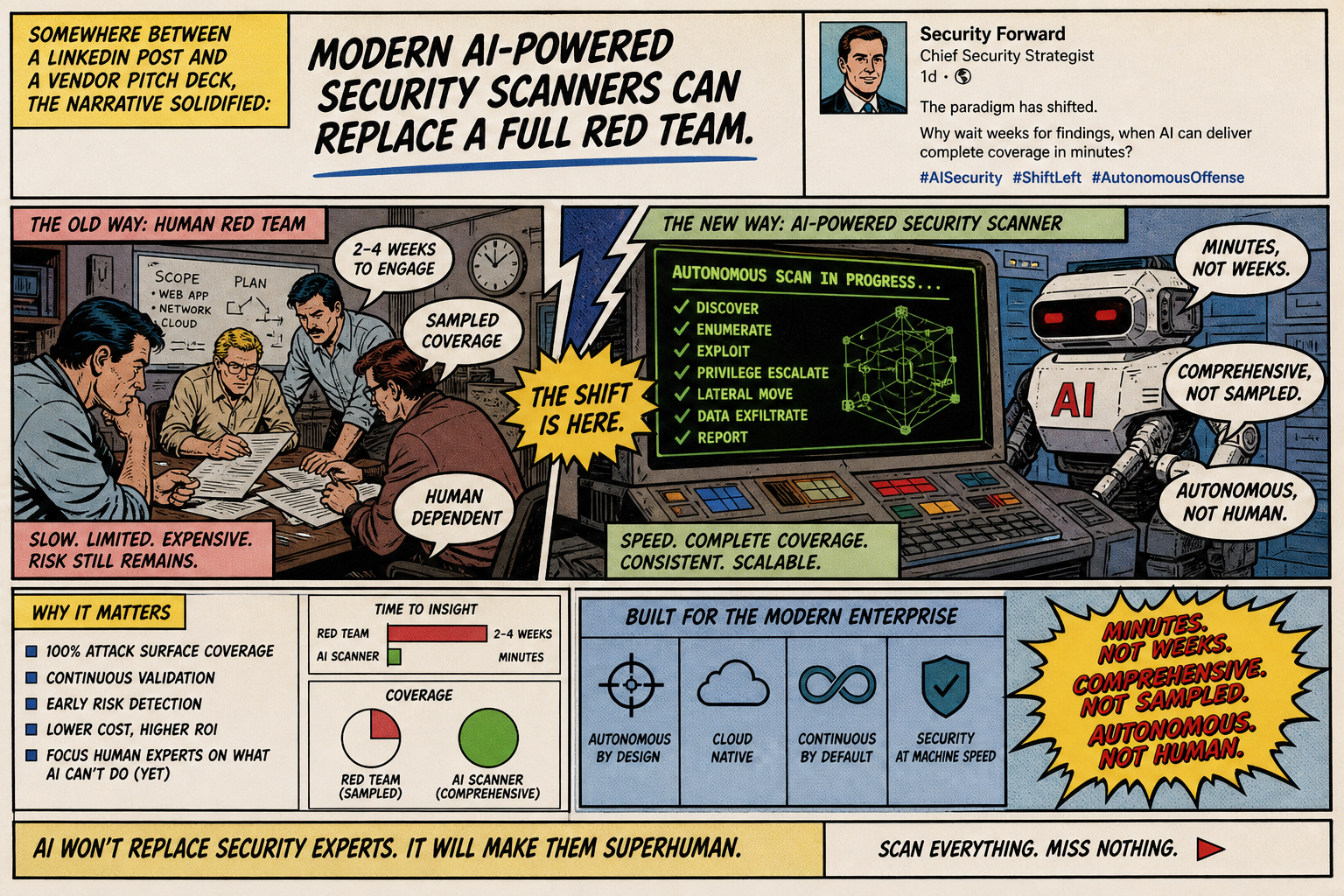
Somewhere between a LinkedIn post and a vendor pitch deck, the narrative solidified: modern AI-powered security scanners can replace a full red team. Minutes, not weeks. Comprehensive, not sampled. Autonomous, not human.
This is not a bold claim. It is a false one.
Let’s work through what AI actually does in a security assessment context, what it cannot do, and why the mythology building up around frontier models in particular — models like Claude Mythos, quietly whispered about in certain circles as some kind of god-mode penetration engine — reveals more about the security industry’s wishful thinking than about the actual capabilities of the technology.
What AI-Assisted Scanning Actually Does Well
To be precise about what is wrong, we first need to be precise about what is right.
AI integration into security tooling is a genuine and meaningful development. The practical gains are real:
Triage acceleration. Traditional scanners produce output volumes that would take a human analyst days to triage. AI-assisted tooling can classify, prioritise, and contextualise findings in ways that genuinely reduce analyst workload. A finding that would have been buried at position 847 in a raw output gets surfaced because the model understands what it means in context.
Pattern correlation across large attack surfaces. Where a human analyst might review one subdomain at a time, AI can hold the entire discovered surface in context simultaneously and identify relationships — a misconfiguration in one place that only becomes exploitable when combined with an exposure in another. This is not trivial. It is genuinely useful.
Natural language reasoning over technical findings. The ability to translate a CVE, a scanner finding, and an environment’s specific configuration into a readable, contextualised risk narrative is something AI does efficiently. The analyst still needs to verify it. But the first draft is accelerated.
Coverage consistency. Humans get tired. Humans have preferences. Humans overlook things at the end of an eight-hour assessment because attention degrades. AI-assisted scanning runs consistently. The same checks at hour one and hour eight.
These are real capabilities. They matter. Tools built on them — Viper, purpose-built red team platforms with AI-assisted correlation layers, vulnerability management systems with intelligent prioritisation — are legitimate workhorses of modern security operations. They make practitioners faster and more consistent. They do not make them redundant.
What AI Cannot Do in a Security Assessment
Here is where the mythology runs into physics.
Zero-days are not discovered by inference. The posts claiming that AI models can surface novel, previously unknown vulnerabilities through automated scanning are making a category error. Zero-day discovery requires genuine understanding of a codebase or system’s internal logic — the kind of understanding that comes from deep, sustained analysis, reverse engineering, fuzzing under specific conditions, and often a combination of domain expertise and creative intuition that remains stubbornly human. An AI model scanning externally cannot discover a zero-day in a target system without either deep authenticated access, aggressive active probing that most organisations will not permit and most tooling will not attempt, or a degree of luck that is not a methodology.
What AI models can do is identify known vulnerability patterns very efficiently. This is valuable. It is not zero-day research.
Black-box scanning has hard limits. The attack surface visible from outside a target network is not the attack surface that matters in a real breach. Serious threat actors don’t enumerate subdomains and call it a day. They get in. Once inside, the actual topology — internal segmentation, trust relationships, service account configurations, lateral movement paths — is where the real exposure lives. An AI-assisted scanner operating externally sees the front door. It has no view of the interior architecture.
Credential and authentication attacks require context. Can AI-assisted tooling identify weak or default credentials? Yes, on exposed services where automated login attempts are within scope and permitted. It can do this efficiently and at scale. But the nuanced question in a mature target — which accounts are privileged, which are dormant, which have over-provisioned roles, which are protected only by legacy authentication mechanisms that bypass MFA — that analysis requires access to identity infrastructure, directory services, sometimes endpoint telemetry. It requires a model with authenticated visibility into the environment, not a scanner running from outside.
Business logic vulnerabilities are not pattern-matched. Some of the most impactful vulnerabilities discovered in real assessments are not CVEs. They are logical flaws in how an application processes a specific business workflow. A payment that can be submitted in a state that should be invalid. An authorisation check that is bypassed by an out-of-sequence request. These require a human to understand the application’s intended behaviour, construct a hypothesis about what happens when that behaviour is subverted, and test it deliberately. No scanner, AI-assisted or otherwise, reliably finds business logic flaws because they have no ground truth about what the application is supposed to do.
On Mythos Specifically
There is a particular conversation happening in certain forums — and more often in vendor-adjacent spaces — about Claude Mythos Preview as though it represents a qualitative leap into autonomous offensive security capability. Let me be direct about this.
Mythos is a frontier model. It is not in public access, is being evaluated under controlled conditions, and the scope of what it can actually do in an offensive security context is not what the mythology suggests. It is a very capable reasoning system. It is not an autonomous red team.
For any AI model — frontier or otherwise — to perform meaningful penetration testing against a real target, it needs several things that the mythology consistently omits:
Authenticated, deep access to the target environment. The model needs to operate inside the network, with credentials, with the ability to enumerate internal resources, read configurations, analyse running services. Without this, it is doing surface reconnaissance. Useful, not comprehensive.
An aggressive operating posture that most engagements explicitly prohibit. Real exploitation — attempting to leverage a discovered vulnerability to gain elevated access, move laterally, escalate privileges — is not something you turn loose on a production environment without carefully scoped rules of engagement. The “AI did a full red team in minutes” narrative conveniently ignores that the scope of an actual red team engagement includes active exploitation, persistence testing, and objective completion, none of which a scanner runs by default.
Legal and regulatory framing that the market is dramatically underestimating. Any tool with genuine autonomous offensive capability will face regulatory scrutiny that scales directly with that capability. The EU AI Act classifies AI systems used for security testing in ways that impose significant obligations. Export controls on advanced AI capabilities are already being applied and will tighten. The fantasy of an autonomous AI red team running freely across enterprise environments collides directly with the regulatory direction of every major jurisdiction. Governments are not going to permit unconstrained AI-driven offensive tooling. Full stop. This is not a prediction. It is already the direction of travel.
The Vendor Narrative Problem
The security industry has a specific failure mode: it sells outcomes to buyers who cannot technically evaluate the claim.
A CISO who came up through compliance rather than technical security hears “AI-powered scanner replaces red team” and has limited means to interrogate it. The vendor demo is controlled. The output looks comprehensive. The price is a fraction of a real red team engagement. The purchase decision feels rational.
It is not rational. It is an informed-sounding substitution of a fundamentally different activity.
A red team engagement is an adversarial simulation conducted by humans with genuine offensive expertise, operating within a defined scope, attempting to achieve realistic objectives against a real environment. It generates findings about what a real attacker could actually do, tested through actual exploitation. The output is not a list of CVEs. It is a narrative of attack paths, demonstrated impact, and evidence of what worked.
An AI-assisted scanner — even a very good one — generates a prioritised, contextualised inventory of known exposures. This is useful. It is not the same thing. Conflating them is either ignorance or deliberate misdirection, and in the security context, the consequences of that conflation are not theoretical.
What a Competent Assessment Actually Looks Like
The honest picture of AI’s role in a modern security assessment is additive, not substitutive.
Competent practitioners use AI-assisted tooling — Viper and equivalents — as the foundation layer. Automated, consistent, fast. It covers the known surface efficiently. It frees analyst time from mechanical triage to strategic reasoning.
Then human expertise operates on top of that foundation: exploring the findings that require contextual judgment, constructing attack chains that require understanding of the environment, testing the business logic that no scanner touches, and pursuing the lateral movement paths that only become visible once you are inside.
The AI layer makes human red teamers faster and more thorough. It does not replace the cognitive capability that makes a red teamer dangerous.
The organisations getting this right are using AI to increase the depth of human analysis per engagement, not to reduce the number of humans in the room. The ones getting it wrong are buying AI scanner subscriptions and calling it done.
The Bottom Line
AI-assisted security tooling is a meaningful advance in the field. Used correctly, it accelerates triage, improves coverage consistency, surfaces context that would take humans longer to develop, and makes good practitioners better.
It does not discover zero-days through external scanning. It does not replace the human judgment required to construct and execute real attack chains. It does not operate autonomously in ways that regulators will permit at scale. And it is not, in any technically honest reading, a substitute for a qualified red team.
The people calling Mythos a god-mode scanner are not practitioners. They are either marketers, or they are reading marketing.
The frontier is genuinely advancing. The mythology is advancing faster. The gap between the two is where real organisations get hurt.
Wolf Schulz is founder of Quantropic, an AI security advisory firm operating across Singapore and Germany, and developer of HADES — Hostile AI Detection and Exploitation System. Quantropic specialises in adversarial AI, LLM attack surface analysis, and red team methodology for organisations operating in high-risk environments.
// COMMENTS
Loading comments…
Leave a comment
No signup. Comments are reviewed before they appear.